
B2C and D2C solutions for companies that sell online, or want to. Handel deploys your entire platform —storefront, admin and backend— on a dedicated instance, in our cloud or on the infrastructure you choose.
Your data is yours. Your platform is yours. No commission on your sales.











Commerce platforms and customer programmes running in production on this technology, across banking, insurance, retail and benefit clubs. Each one runs on its own instance, with its own brand and its own rules.
A company with stores, distributors or a sales force already has scale, and it also has a ceiling: it only sells where it built operations. The digital channel moves that ceiling without opening another location, and along the way it hands you something the traditional chain never did — knowing exactly who your end customer is.
Selling abroad does not require another platform, another project or another vendor: it requires an international logistics operator to pick the order up and carry it. That connection is already solved, because our logistics integration API is built and proven. Exporting becomes a commercial decision of yours, not a development project starting from zero.
Opening the digital channel does not force your customer to buy unassisted. Our phone-sales module lives inside the same backoffice and reads the same catalogue, the same prices and the same campaigns: your agent takes the order over the phone and it enters as one more sale on the channel, with the same stock, the same payment and the same reporting. The call centre stops being a separate channel you have to reconcile at month end.
Run the numbers on your own business. A company turning over twenty million dollars that moves ten per cent through its digital channel has two million dollars a year passing through a piece of software. At that scale the system stops being a technology detail: it decides how far the channel can grow, what growing it costs you, and who owns your customers' data.
Latin America figures: eMarketer (regional retail e-commerce sales and growth rate, 2025), Statista via IPG Mediabrands (digital shoppers) and eMarketer (mobile share of regional e-commerce, 2022, still rising). Worth refreshing before the site goes live.
That is how software as a service works: one application and one database serve every customer at once, and what separates your company's information from everyone else's is a column in a table. For plenty of companies that is fine. For a bank, an insurer or anyone handling sensitive data, it is precisely what they cannot accept.
On a shared service your customers' information lives on somebody else's infrastructure, under policies you do not set and sometimes in a country you did not choose.
When the shared platform has an incident, everyone has it at once. Your store goes down because of something that did not happen at your company, and there is nothing you can do about it.
The vendor updates when it suits their calendar, not yours. If that lands on your biggest campaign of the year, that is your problem.
You share capacity with companies you do not know. The day one of them has a great day, your store answers more slowly.
It is the same software and the same project in all three options. The only thing that changes is who administers the infrastructure, and your company makes that call according to its own policies, not according to what we happen to sell.
We deploy and administer your instance on our AWS infrastructure. It is still yours and still independent: you share it with no other client. You need no infrastructure team.
Your account, your provider, your security policies and your IT team in charge. We deploy and maintain the software inside the environment your company has already approved.
Installed inside your own infrastructure, with no public cloud involved. This is the option for anyone with regulatory requirements or a data policy that does not allow third parties.
Your own database. Your company's information shares no table, no schema and no server with any other client's.
Your credentials, your access. The keys to your platform and your integrations belong to your company, not to a shared console.
Auditable. Your security team can review the code, the configuration and the infrastructure, because all of it sits in your project.
Portable. If you decide to change cloud provider or bring it in-house, it moves. Nothing is tied to somebody else's platform.
If your company has its own security framework or a list of controls a vendor must meet, we go through it point by point before signing.
These are the complaints that come up at every mid-size and large company already selling online that has started to feel its platform's ceiling.
Your platform charges a percentage of your sales, or a licence tied to your turnover. The software does not cost more because it gives you more: it costs more because you are doing well.
With Handel: a fixed licence. Zero commission.Your business rule does not fit the platform and the answer is "that is not possible" or "install an extension". Checkout, which is exactly where sales are lost, is usually the most locked-down part of all.
With Handel: we modify your project's code.Your ERP, your local payment gateway, your logistics operator or your customer system are not in the connector catalogue, and every integration turns into a long consulting engagement.
With Handel: the integration is part of the project.You request a feature and join a global queue. Your priority competes with thousands of other customers and almost never wins.
With Handel: your project has a roadmap of its own.Shopify, VTEX, Magento and Riqra are good platforms. The difference is the model: they rent you a service capped by a plan; we hand you software your company controls, with no ceiling and with the pieces almost nobody ships as standard.
| Shopify Plus | VTEX | Magento / Adobe Commerce | Riqra | Handel | |
|---|---|---|---|---|---|
| How they charge you | Subscription plus a variable commission on your turnover | Pricing tied to sales volume | Annual licence based on turnover, plus cloud and implementation | Monthly subscription by plan, no commission per sale | Software licence, setup and development. No commission on sales |
| Plan limits | Whatever the plan allows | Based on committed volume | Based on your turnover band | Entry plan capped on monthly orders, products and users | No cap on orders, products or users |
| Who you share a server with | Every other customer on the platform | Every other customer on the platform | Nobody if you self-host; everyone on Adobe's cloud | Every other customer on the platform | Nobody. The instance and the database are yours alone |
| Where it runs | The vendor's cloud | The vendor's cloud | Adobe's cloud or your own infrastructure | The vendor's cloud | Our cloud, your company's cloud or your data centre |
| Source code | Not provided | Not provided | Available, with the cost of maintaining and upgrading a very large codebase | Not provided | Provided, and sold outright if you want it |
| Custom changes | Apps and extensions; the core is untouchable | Apps and extensions; the core is untouchable | Yes, with a development and maintenance project of your own | Configuration; the core is untouchable | We change your project's code, with no effect on any other client |
| Campaigns and promotions | Discount engine with predefined rules | The platform's promotion engine | Catalogue and cart rules, with development for anything specific | Commercial policies and price lists, capped by plan | Dozens of logic rules you can combine, and anything missing gets built |
| Vouchers, coupons and loyalty | Third-party apps, charged separately | Third-party apps, charged separately | Third-party extensions | Not part of their offering | Built into the platform: issuing, expiry, redemption and segments |
| Recurring billing | A third-party app | Depends on the module you buy | A third-party extension | Not part of their offering | Our own engine, built in, with retries, card updates and reconciliation |
| Phone sales | No, unless you add external tools | No, unless you add external tools | No, unless you add an extension and development | Their assisted channel is messaging | Phone-sales module in the same backoffice, on the same catalogue |
| Who runs the platform | Your team, or an agency you hire separately | Your team, or an implementation partner | Your team, or an implementation partner | Your team, or an implementation partner | Your team, or us: content, storefronts, campaigns and catalogue as a service |
| Your ERP, your gateway, your logistics operator | Whatever is in the catalogue; the rest has to be built | A broad catalogue; anything specific has to be built | Third-party extensions and development | A defined integration catalogue | Any of them, as part of the project rather than a catalogue |
| Living alongside your systems | Through integration | Through integration | Through integration | Through integration | It can run on your existing database and hand the information back to your system |
This comparison is built from each platform's publicly stated terms. Every vendor negotiates specific terms with each client; if your company has a contract in force, we will go through it with you line by line.
You pay for the licence, the setup and the development of your customisation. The platform is deployed on your infrastructure and stays under your control. From then on, whatever you sell is yours.
Your own Handel instance, customised and deployed wherever you say.
We are the only ones who sell their own technology. If your company wants complete autonomy, it takes the code and your team evolves it.
If you would rather not run anything in-house, we operate the platform for you: the infrastructure, the day-to-day configuration and the whole programme.
None of the three models includes a commission on your sales. If your digital channel doubles its turnover next year, your software costs exactly the same.
Every Handel project is independent and runs on its own server. That is why we can modify your platform's code without affecting any other client. On a shared service that is impossible: the same code serves thousands of companies and nobody can touch it for one of them.
If tomorrow your business needs a new pricing rule, an approval flow, a different kind of product or a screen that exists on no platform on the market, there is no waiting for somebody to put it on a roadmap. You think of it, we talk it through, we build it.
Your instance, your database. Nothing is shared with other clients — not the server, not the data.
Changes in the core, not just the surface. Checkout, pricing rules, order flows: all of it can be changed.
Your roadmap decides. What your business needs gets built when your business needs it.
Without losing the platform's improvements. The shared core keeps being updated and your customisation is kept separate.
Almost everyone starts by selling their own catalogue. When the business calls for opening up to other sellers, the same platform does it: no change of software, no starting over. It is configuration, not a new project.
Your catalogue, your campaigns, your checkout and your fulfilment. Your brand's store, with your operation behind it.
Other sellers trading under your brand, each with their own portal, commissions, logistics operator and settlements, with every order managed from one place.
The first four blocks are commerce: catalogue, payment, operations and order management. The next two are the difference: the platform keeps every customer's history and, on top of that, lets you show each segment its own store and its own prices. The last two are optional services you can add later, without changing platform or vendor.
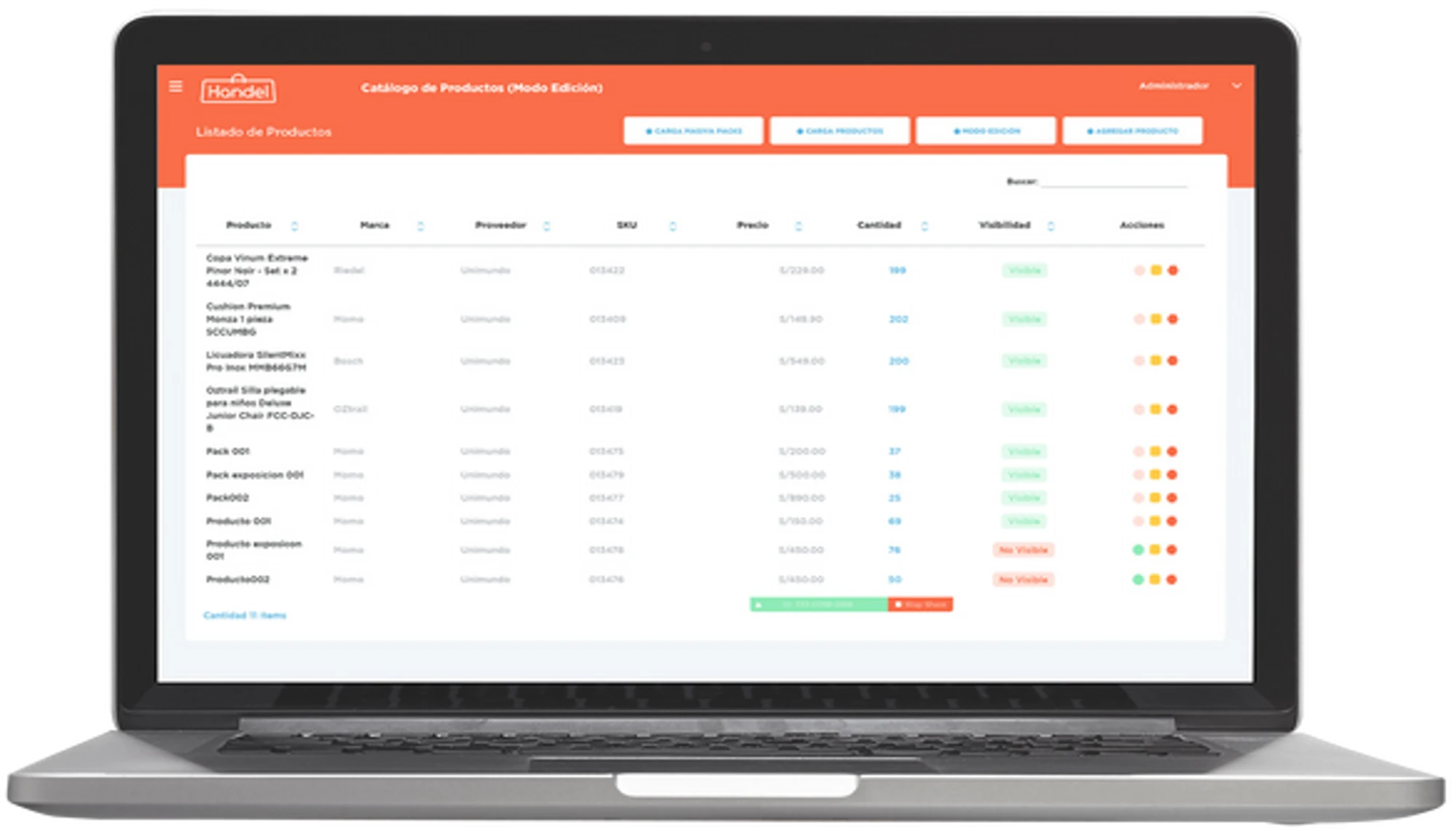
The selling engine, configurable by your own team.
The part where the sale is won or lost, built to handle real money.
What happens after the purchase, which is where the experience usually falls apart. And the order that did not start on the web: your agent takes it by phone from the same backoffice.
The control room for fulfilment: every order with its status and the history of the stages it went through, and your ERP writing that status live. And the part almost nobody shows you: the sale that never went through and the exact checkout step where it dropped, so your team can win it back.
The customer module keeps every person's purchase history: what they bought, when, and how often they come back. Your company stops selling to strangers and starts selling to the people who already bought from you.
Several stores inside one platform. Each customer segment walks into its own storefront, with its own logo, its own colours, its own catalogue, its own brands and its own banners. And the part that matters most: its own prices. The wholesaler sees their list, the corporate client sees theirs and the general public sees the usual one, with no duplicated operation and no second ecommerce to build.
A step beyond what the platform already includes: a card programme with its own balance, points and a redemption catalogue. The integration is ready, and we implement it when you decide to go there.
Our own recurring-billing engine, already integrated into the platform. For subscriptions, memberships and any charge that has to repeat on its own, month after month.
Your platform's backoffice ships with a live dashboard carrying the numbers people actually look at every day, and it brings your Google Analytics navigation data into the same place. Your commercial manager logs in and sees the business; they do not wait until Monday or depend on somebody in IT exporting a file.
The business's headline numbers, updated live: how much sold today, how many orders came in, what the average basket is worth, which products are moving and how the month compares with the last one. All inside the platform, with nothing to export.
We connect your Google Analytics account to the backoffice and pull the navigation KPIs to where the sales numbers already are: sessions, traffic sources, most-viewed pages, behaviour by device and conversion. Not having to jump between two tools is what makes the data actually get used.
And if your company measures something no standard dashboard ships with, it gets added: your project's code is yours and the report comes in as part of the work, not as a feature you have to wait for.
Two customers walk into the same store and see the same thing. That is the most expensive waste in e-commerce: you paid to bring the traffic in and then showed everyone the same window. We work with artificial intelligence so your platform recognises what each person is interested in and builds the offer around it.
The platform learns from what each person searches for, looks at and buys, and reorders the home page, the categories and the featured products accordingly. The customer finds what they want sooner, and you sell more on the same traffic.
Customers type the way they talk, not the way your product is catalogued. Semantic search reads the intent and returns the right thing even when the words do not match, instead of showing the dreaded no-results page.
AI-assisted product descriptions, titles, attributes and categorisation. Loading two thousand products stops being a months-long project for the content team.
The artificial intelligence works on your own platform's data, which lives on your instance and in your database. We do not feed your information into a model shared with other companies.
We do not depend on a connector catalogue. Because your project's code is yours and we can modify it, the integration your company needs comes in as part of the project rather than as a platform limitation.
And something rarely on offer: the platform can run on the database your company already uses and hand the information back to your current system, so the migration is gradual rather than a hard cutover. We do this today, in production.
When the project needs no integrations with external systems, your channel can be selling in under fifteen days. The platform is already built and proven in production: the work is configuring it and dressing it in your brand, not building it from scratch.
Your instance goes up on your server or your cloud, with your domain and your certificates.
Theme, identity and loading of products, categories and content.
Gateway, delivery methods and end-to-end purchase testing.
Final adjustments, training for your team and opening to the public.
Projects involving ERP integration, customer systems or custom development take longer, and the proposal says exactly how much longer.
Change the colour and the shape and watch real platform components respond. This is the same mechanism we use to dress your brand: the theme is redefined, the system is not rebuilt.
In your project these are your brand's theme variables. Dressing a new brand does not mean forking the software.
Banco de la Nación's benefits programme for its Visa cardholders, built on Handel technology. It is live and anyone can browse it.

Discounts and promotions across thousands of products and partner merchants, on a complete commerce platform: catalogue, cart, checkout and customer account, with vouchers, experiences and affiliated merchants in the same system. Sized to serve more than five million customers.
If it holds up to the security requirements of a state bank and a global payments brand, it will hold up at your company.
The same team that develops and maintains the platform works as a software factory. Many clients start with their sales channel and end up handing us the rest of their software, because we already know their business, their systems and the way they work.
Corporate sites, campaign landing pages, customer or supplier portals and intranets. Fast, measurable and properly on brand.
Apps for iOS and Android, published on the stores and connected to the systems your company already runs, including your own commerce platform.
Internal systems, integrations between platforms, automations and anything else with no off-the-shelf product that fits as it comes.
One vendor, one contract and a team that already understands your business. We can talk it through in the same meeting.
Your platform. Your server. Your code.
Next stepWe will walk through your case on the real system, not a slide deck. And we will leave you a proposal with the cost of the licence, the setup and the customisation, so you can compare it with what you pay in commissions today.